

Financing
A fully fundable advanced training course
This training is a non-certifying, advanced course designed for professionals looking to dive deep into Volkswagen, Audi, Seat, Škoda, and Cupra immobilizer systems. Depending on your situation, it can be funded by your employer, your OPCO, or through self-funding. EMS Electronics will assist you in preparing your quote, training agreement, and all the necessary paperwork for your file. A personal certificate of completion is provided at the end of the day. Please note, this training does not prepare you for any registered certification and does not award any official title or degree.




50 hours In-Person Training + E-Learning Content
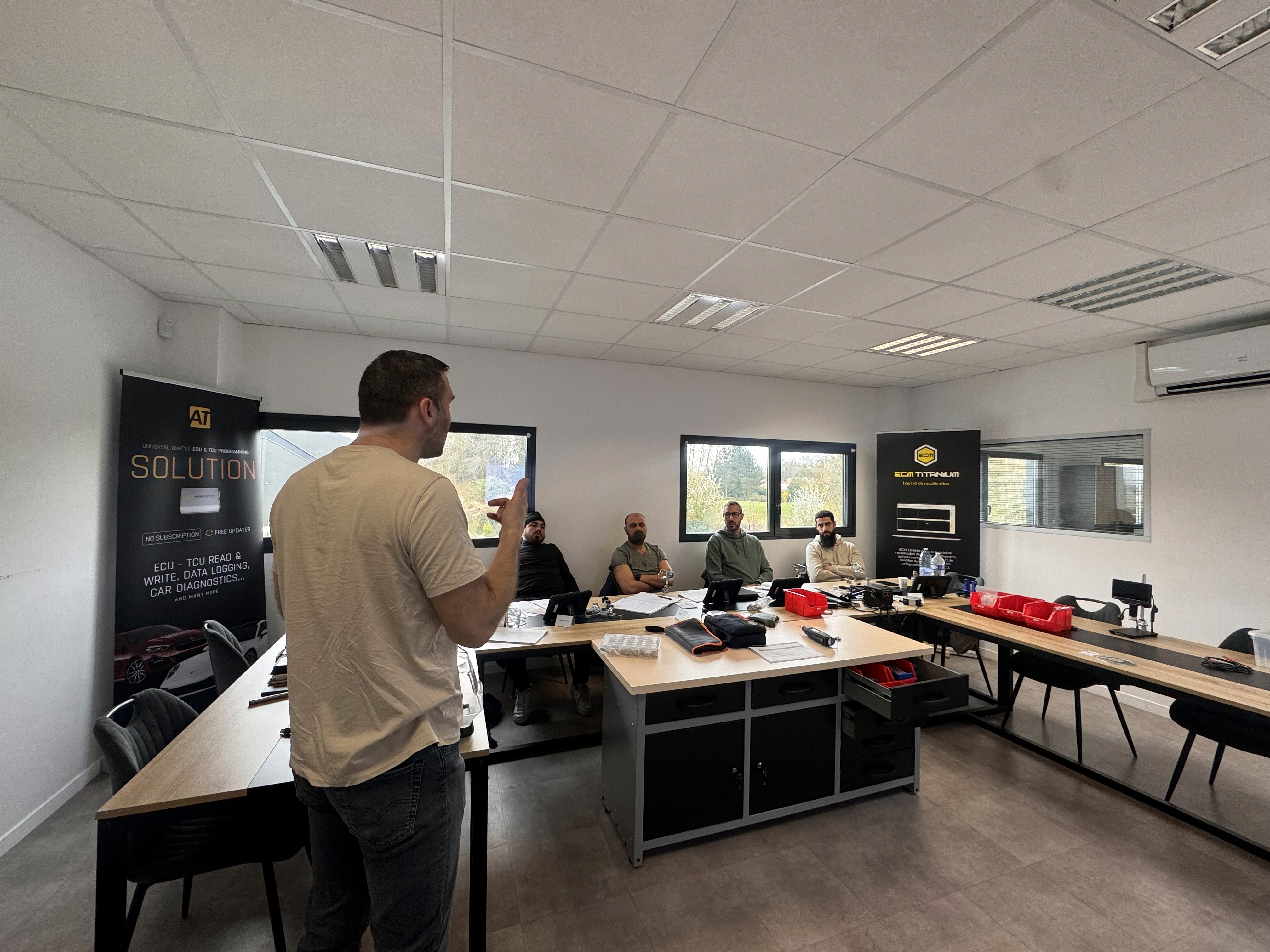
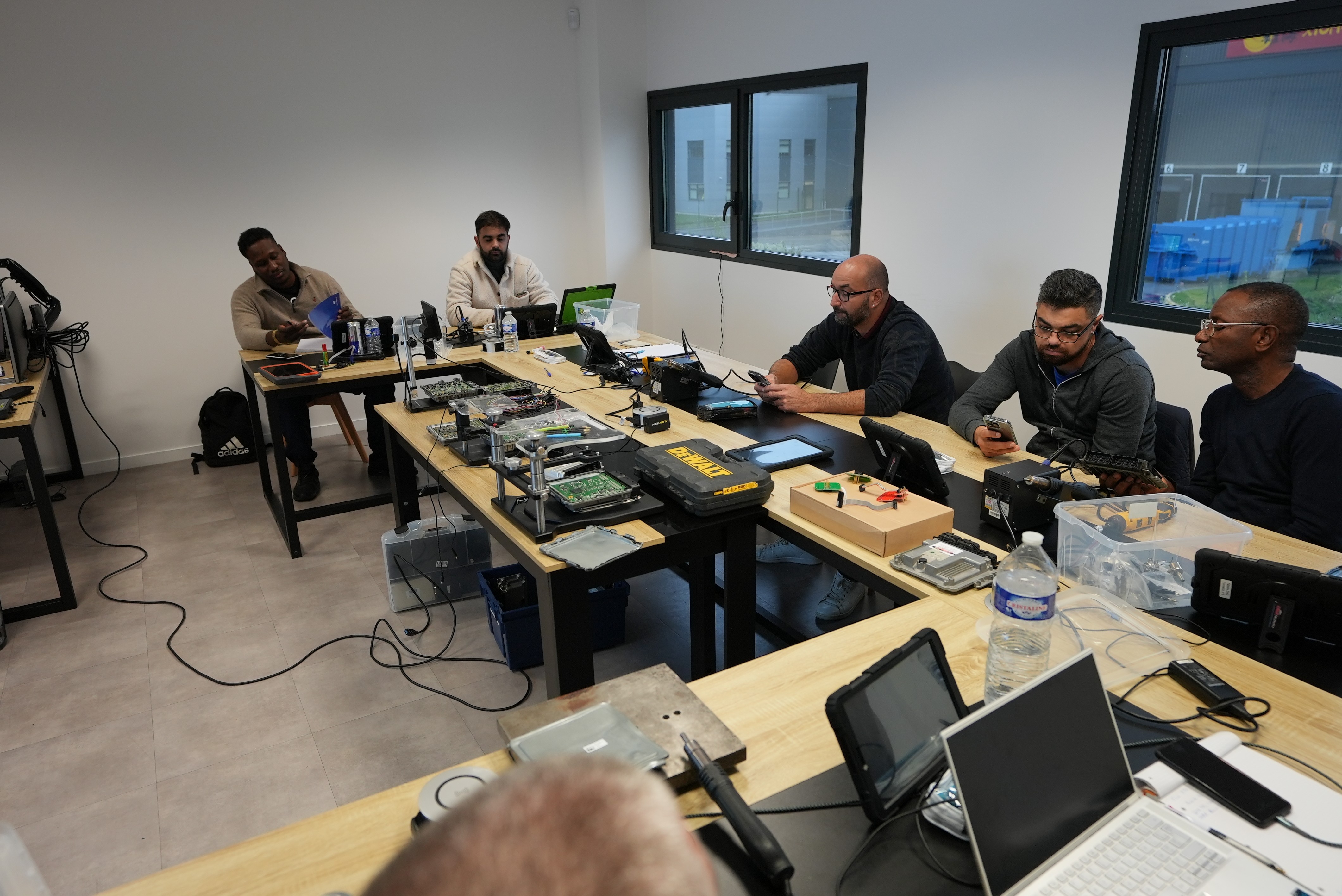
Cette formation se déroule en présentiel, en groupe à effectif réduit, dans les locaux EMS Electronics à Saint-Pierre-du-Perray.
Vous alternez apports techniques, démonstrations commentées, études de cas et ateliers encadrés sur matériel pédagogique. Deux formateurs vous accompagnent pendant la journée afin de vous faire progresser avec méthode, sécurité et traçabilité.
Lieu : Centre EMS Electronics, Saint-Pierre-du-Perray (91)
Pré-requis : Vous devez maîtriser les familles de transpondeurs, les principes de lecture OBD, Bench et Boot, la soudure électronique, l’utilisation d’une alimentation stabilisée et d’un multimètre, ainsi que les précautions ESD.
Public concerné : Professionnels de l’automobile et de la serrurerie souhaitant approfondir les systèmes antidémarrage du groupe VAG.
Accessibilité : Notre format a été conçu pour s’adapter aux personnes résidant loin ou ayant des contraintes professionnelles.
Délais d’accès : Sessions tous les mois ; démarrage possible sous 30 jours après validation de votre dossier.
Handicap : Pour toute situation de handicap ou besoin spécifique, contactez-nous afin d’étudier les solutions d’adaptation possibles.
PRIX : 790€ net
INTRODUCTION & PRESENTATION
What you will learn
This training helps you better identify VAG architectures, structure your diagnostics, and secure your decisions when dealing with WFS, BCM2, MQB, MLB, and Component Protection systems.
Identify VAG platforms
You will learn to place the vehicle in the correct generation and identify the main elements of the architecture involved.
The PQ25, PQ35, and PQ46 platforms.
The MQB, MQB A0, and MQB Evo platforms.
The MLB and MLB Evo platforms.
The WFS1 to WFS5 systems.
The BCM2 sets.
The Component Protection benchmarks.
The generations and architectures of the VAG group.
Locate the boxes and data carriers
You’re developing a method to identify the components that are actually useful for diagnosis and select the right control framework.
The memory families.
The instrument cluster, or Kombi.
The J533 Gateway.
The BCM computers.
The Kessy systems.
ELV steering column locks.
The engine control units.
The vehicle’s references and electronic environment.
Securing data and backups
You’ll learn how to plan an intervention with proper documentation, verified backups, and strict compliance with traceability requirements.
The retention of useful data.
The backups before analysis.
The authoritative sources.
The verification of information integrity.
Using a regulated power supply.
The electronic safety rules.
The duty of traceability.
Business continuity in a professional environment.
Understanding SFD and SFD2
You will discover the manufacturer security constraints related to SFD and SFD2, helping you better determine the right service path or necessary guidance.
The role of SFD and SFD2.
Constraints related to the manufacturer’s environment.
The limits of generic tools.
The referral criteria.
The authorized manufacturer channels.
Working with an authorized partner.
The information to be sent to the client.
Diagnose Component Protection
You learn how to recognize the symptoms and structure the analysis of a Component Protection situation, specifically on the affected Audi generations.
The Audi Generation 1 Component Protection.
The Audi Generation 2 Component Protection.
The observable symptoms.
The expected controls.
The analysis of the affected area.
Scope of work.
The manufacturer options to prioritize.
C1 focused on ECU data extraction and management
Locate the WFS, BCM2, MQB, and MLB keys
You will cover the main environments related to keys, transponders, and the latest platforms from the VAG group.
WFS keys.
The BCM2 control modules.
The MQB platforms.
The MLB and MLB Evo platforms.
Transponder families used as identification markers.
The constraints related to backups.
Preparing an application file.
Complete traceability of the service.
Locate the vehicle in the correct generation
You start with the platforms and generations of the VAG group in order to identify the architecture, the control units, and the associated constraints.
Ramps and immobilizers
PQ25, PQ35, PQ46, MQB, MQB A0, MQB Evo, MLB and MLB Evo; WFS1 to WFS5 systems, BCM2 and Component Protection landmarks.
Data Storage and Security
Memory families, Kombi, J533, BCM, Kessy, ELV and engine control unit; backups, authorized sources, SFD and SFD2.
Getting a clear diagnostic before making any moves
You will cover the symptoms, checks, and limits related to Component Protection, control unit replacements, and coding projects.
Component Protection and coding
Audi generation 1 and 2 scopes, symptoms, checks, manufacturer channels, compatibility analysis, consistency, and coding or cloning limitations.
Keys, BCM2 and MQB
Architectures, packages, and transponder families. Case studies, demand analysis, and structured decision-making.
Prepare a compliant and documented intervention
You end the day with the MLB platforms and the essential checks before handing over an intervention or directing the case file.
MLB and MLB Evo
BCM2, Gateway, Component Protection, post-intervention checks, SFD limits, and routing criteria.
Technical Fundamentals (C1-C4)
Review of the platforms, case study, validation of acquired skills, individual assessment, and progress plan on the manufacturer systems.
A training session to better identify VAG immobilizer systems, secure your analyses, and make documented decisions in the shop.
VOUS AVEZ ENCORE DES DOUTES ?
FAQs
Here are the answers to the questions we are most often asked.
Who are EMS programs designed for?
Where do classes take place?
When can I enroll, and how does it work?
Are there financing or funding options available?
Do I need prior experience to join a full certification program?